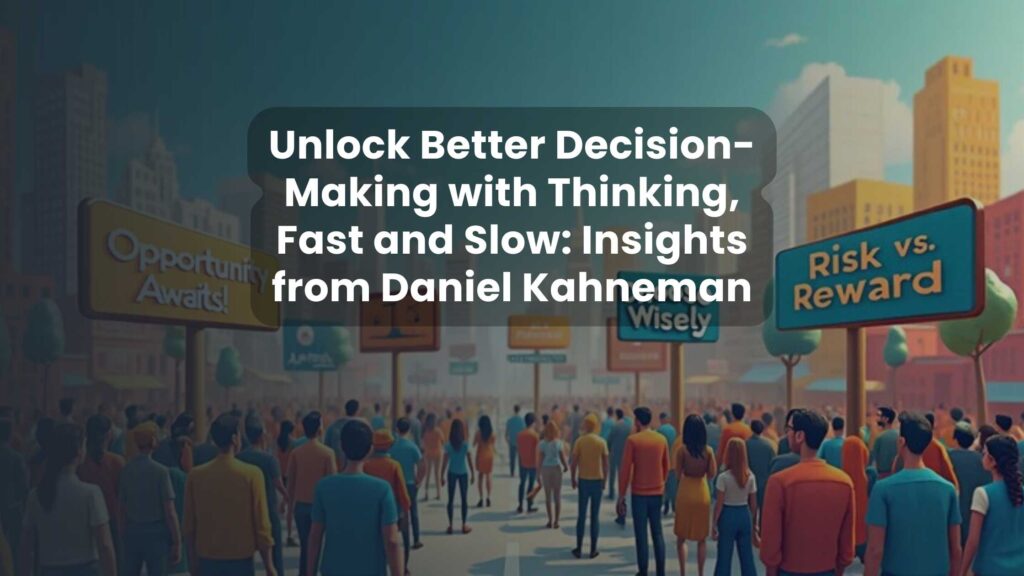
Unlock Better Decision-Making with Thinking, Fast and Slow: Insights from Daniel Kahneman

In a world brimming with choices, the ability to make sound decisions is an invaluable skill that can shape the trajectory of our lives. Daniel Kahneman’s groundbreaking work, “Thinking, Fast and Slow,” delves deep into the psychology of decision-making, revealing the intricate processes that govern our thoughts. At the heart of this exploration lies a compelling dichotomy: System 1 and System 2. System 1 operates swiftly and effortlessly, guiding us through everyday situations with intuition and instinct. In contrast, System 2 is methodical and deliberate, requiring conscious effort and analysis.
Understanding the interplay between these two systems is crucial for navigating the complexities of modern life. Kahneman’s insights illuminate how mental shortcuts, or heuristics, can simplify decisions but also lead us astray, often resulting in cognitive biases that cloud our judgment. From the pervasive influence of confirmation bias to the profound impacts of loss aversion outlined in Prospect Theory, these concepts challenge us to reconsider our thought processes.
As we delve into the mechanics of decision-making, we will explore how framing can alter our perceptions and the importance of humility in mitigating overconfidence. By becoming aware of these cognitive pitfalls, we can better equip ourselves to make informed choices that resonate with our values and aspirations. Join us on this journey to unlock the secrets of better decision-making and harness the power of our minds in ways that lead to more fulfilling outcomes.
The Dichotomy of Thought: Understanding System 1 vs. System 2
Explore how Kahneman’s distinction between fast, intuitive thinking (System 1) and slow, deliberate reasoning (System 2) affects our daily decisions.
Daniel Kahneman’s exploration of human cognition reveals a fascinating dichotomy in our thought processes: System 1 and System 2. System 1 operates automatically and quickly, relying on intuition and gut feelings to navigate the world. This form of thinking is responsible for our immediate reactions, such as pulling our hand away from a hot surface before we consciously register the pain. In contrast, System 2 engages when we require deeper analysis and more deliberate reasoning. It is the part of our mind that grapples with complex calculations, strategic planning, and challenging decisions, like evaluating the pros and cons of a significant life change. Understanding when to switch between these systems can profoundly influence our daily decisions, allowing us to harness the strengths of both intuitive and analytical thinking.
Heuristics, or mental shortcuts, frequently emerge from System 1, enabling us to make swift judgments without extensive deliberation. While these shortcuts can be efficient, they also expose us to cognitive biases, such as the anchoring effect. For instance, if we see a high initial price for a product and then encounter a sale, our perception of the discount may skew our judgment about the product’s true value. Being aware of these heuristics can empower us to question our assumptions and consider alternative viewpoints, ultimately leading to more informed decisions. By recognizing when we are relying too heavily on intuitive thinking, we can consciously engage System 2 to reassess our choices and mitigate potential errors.
Cognitive biases like confirmation bias further complicate our decision-making processes. This bias occurs when individuals favor information that aligns with their pre-existing beliefs, often overlooking contradictory evidence. As a result, our judgments can become skewed, stifling creativity and innovation, particularly in collaborative environments. For example, in a workplace setting, a team may repeatedly pursue a failed strategy simply because it aligns with their established views, neglecting fresh ideas that could lead to success. By fostering an environment where diverse opinions are welcomed and valued, organizations can challenge the confines of confirmation bias, encouraging more robust discussions and better decision-making.
Prospect Theory provides additional insights into how we perceive risks and rewards, highlighting the tendency for losses to weigh more heavily on our psyche than equivalent gains. This principle suggests that people often prefer to avoid losses rather than pursue gains, which can lead to overly cautious behavior. For instance, an investor may hold onto a declining stock in hopes of breaking even rather than accepting a loss and reallocating funds to a more promising opportunity. Understanding this inclination allows individuals to make more rational financial choices, as they can learn to reframe their perspectives on risk and reward, ultimately leading to more calculated and beneficial decisions.
Overconfidence is another cognitive bias that can adversely influence our decision-making. Individuals often overestimate their knowledge and abilities, leading to reckless choices based on inflated self-assessments. For example, a manager may confidently pursue a new project without adequately assessing potential pitfalls, only to encounter significant setbacks. To counteract overconfidence, seeking feedback from peers and considering alternative viewpoints can ground our decisions in reality. Embracing humility and recognizing our limitations not only improves our decision-making quality but also creates a culture of accountability and open dialogue within teams.
Finally, the framing of information plays a crucial role in shaping our decisions. The way a choice is presented can significantly influence our preferences and choices. For example, conveying the success rate of a medical treatment as a “90% survival rate” is likely to elicit a more favorable response than stating it as a “10% mortality rate,” even though both statements convey the same information. This demonstrates how subtle variations in language can lead to different emotional responses and decision outcomes. By prioritizing clear and accurate communication, we can enhance our understanding and promote better-informed choices in various contexts. Through awareness of these dynamics, individuals can navigate their decision-making landscapes with greater insight and efficacy.
The Role of Heuristics in Everyday Choices
Delve into how mental shortcuts help us navigate decisions but may introduce biases that cloud our judgment.
Heuristics play a crucial role in our daily decision-making processes by providing mental shortcuts that allow us to navigate the complexities of life with greater ease. These cognitive strategies enable us to make quick judgments without extensive deliberation, which can be immensely beneficial in situations requiring rapid responses. For instance, when we encounter a crowded restaurant, we might rely on the heuristic that a full establishment is likely to offer better food than an empty one. This quick assessment saves us time and energy, preventing the paralysis of over-analysis. However, while heuristics can streamline our choices, they can also introduce biases that distort our judgment, leading us to make decisions that aren’t always in our best interest.
One prominent example of how heuristics can cloud our judgment is the anchoring bias, where individuals give disproportionate weight to the first piece of information they encounter. In a shopping scenario, if a customer sees a jacket discounted from $200 to $100, they may perceive it as a great deal based solely on the initial price, even if similar jackets are available for $80 elsewhere. This reliance on the anchor can lead to a skewed perception of value and result in poorer decision-making. Such cognitive biases often operate below our conscious awareness, making it essential for individuals to develop an understanding of these mental shortcuts. By recognizing the potential pitfalls of heuristics, we can challenge our assumptions and consider alternative perspectives, ultimately leading to more informed decisions.
The impact of cognitive biases extends beyond individual choices; they can significantly shape group dynamics and organizational decision-making as well. For example, confirmation bias, which leads individuals to favor information that supports their existing beliefs, can stifle innovation and creativity within a team. When group members are unwilling to entertain dissenting opinions, valuable insights may be overlooked, reducing the quality of decisions made. Embracing a culture that encourages diverse viewpoints and critical feedback can mitigate the effects of such biases, fostering an environment where more comprehensive and effective solutions can emerge.
Prospect Theory further elucidates the complexities of decision-making by highlighting how people perceive gains and losses. According to this theory, losses tend to weigh heavier on our psyche than equivalent gains, leading to risk-averse behaviors. For instance, a person might avoid investing in stocks due to the fear of losing money, even when the potential for gain is significantly higher. Understanding this psychological tendency can empower individuals to approach financial and personal decisions with a more balanced perspective, prompting them to embrace calculated risks that could lead to greater rewards.
Overconfidence is another cognitive bias that can skew our decision-making processes, as individuals often overestimate their knowledge and abilities. This inflated self-assessment can result in taking unnecessary risks, whether in business ventures or personal life choices. By actively seeking feedback and engaging with differing viewpoints, we can ground our decisions in reality and mitigate the dangers of overconfidence. Embracing a mindset of humility allows for a more accurate self-assessment and better decision-making outcomes.
Furthermore, the framing effect illustrates how the presentation of information can significantly influence our choices. For example, a medical procedure described as having a “90% survival rate” appears more favorable than one with a “10% mortality rate,” despite conveying the same information. This subtle shift in wording can lead individuals to make vastly different decisions, underscoring the importance of clear and thoughtful communication in decision-making contexts. Being aware of framing effects can help individuals critically evaluate information and make choices that align with their true interests and values.
Enhancing decision-making is a multifaceted endeavor that requires an awareness of cognitive biases and a willingness to reflect on past choices. Practicing mindfulness can serve as a valuable tool in this process, enabling individuals to pause and evaluate their thought processes before acting. By actively engaging with diverse perspectives and considering alternative options, we can cultivate a more robust decision-making framework that aligns with our goals and values. Through this journey of self-awareness and critical reflection, individuals are better equipped to navigate the complexities of everyday choices and make decisions that truly serve their best interests.
Unpacking Cognitive Biases: A Path to Better Judgment
Cognitive biases are inherent flaws in our thinking that can significantly distort our judgment. Understanding these biases is crucial for making sound decisions, both in personal and professional contexts. For instance, Daniel Kahneman’s groundbreaking work in “Thinking, Fast and Slow” categorizes our thought processes into two systems: System 1 and System 2. System 1 operates on instinct, facilitating quick, intuitive reactions, while System 2 engages in thoughtful analysis and deliberation. By recognizing when we are relying on each system, we can enhance our decision-making effectiveness and strive for more balanced judgments.
Heuristics, the mental shortcuts we frequently employ, play a pivotal role in our daily decision-making. While they can streamline our thought processes, they also introduce the risk of cognitive biases. A prime example is anchoring bias, where an initial piece of information unduly influences our subsequent judgments. For instance, if a car is initially priced at $30,000 and later reduced to $25,000, the perception of value may be skewed by that initial anchor, leading buyers to feel they are getting a significant deal, even if the car’s true value is much lower. By cultivating awareness of these heuristics, we can challenge our assumptions and explore alternative perspectives, ultimately making more informed choices.
The impact of cognitive biases extends beyond individual decisions; they significantly shape group dynamics and organizational effectiveness. Confirmation bias, for example, can result in teams overlooking valuable ideas that contradict their established beliefs. This tendency stifles creativity and innovation, as diverse opinions are essential for robust decision-making. Encouraging an environment where differing viewpoints are embraced can lead to richer discussions and more effective solutions. Organizations that actively seek out diverse perspectives not only enhance their decision-making processes but also foster a culture of inclusivity and adaptability.
Prospect Theory further elucidates how we perceive gains and losses, highlighting a critical aspect of human psychology: the tendency to react more strongly to losses than to equivalent gains. This insight is pivotal in various fields, especially in finance, where it can guide individuals toward more rational decision-making. For example, a person may be hesitant to invest in stocks due to a fear of potential losses, even if the expected gains outweigh the risks. By understanding this psychological bias, individuals can become more attuned to their risk tolerance and make calculated decisions that lead to better outcomes.
Overconfidence is another cognitive bias that can cloud judgment, leading individuals to overestimate their knowledge and abilities. This often results in risky choices, such as underestimating the complexities of a project or disregarding critical feedback. By actively seeking input from others and considering opposing views, we can ground our decisions in reality and mitigate the pitfalls of overconfidence. Embracing humility and acknowledging the limits of our knowledge fosters a more cautious and reflective approach to decision-making, ultimately improving the quality of our choices.
The framing effect illustrates how the presentation of information can significantly influence our decisions. For instance, framing a medical procedure in terms of a “90% survival rate” versus a “10% mortality rate” can evoke vastly different emotional responses, despite conveying the same statistical information. This highlights the importance of clear communication in guiding decisions. In various contexts, whether it be healthcare, marketing, or policy-making, understanding framing effects can lead to better-informed choices that align with our true needs and values.
Improving decision-making is a continuous journey that involves recognizing our cognitive biases and reflecting on past choices. Practicing mindfulness can aid in evaluating our thoughts before taking action, ensuring a more thoughtful and deliberate approach. Engaging with diverse perspectives not only enriches our decision-making process but also aligns our choices with our core values and goals. By remaining vigilant and open-minded, we can navigate the complexities of judgment with greater clarity and effectiveness.
Prospect Theory: The Psychology of Gains and Losses
Discover how Prospect Theory influences our perception of risk and reward, emphasizing the greater emotional weight of losses over gains.
Prospect Theory delves into the intricacies of how we perceive gains and losses, revealing a fundamental truth about human psychology: the pain of losing is often felt more acutely than the pleasure of an equivalent gain. This asymmetry suggests that individuals may take greater risks to avoid losses than to achieve gains, a phenomenon that can lead to irrational decision-making. For instance, a person might choose to gamble in hopes of recovering a lost sum rather than walking away with a smaller but guaranteed win. This inclination to prioritize loss aversion can significantly influence financial behaviors, such as holding onto losing stocks for too long in the hope of a turnaround, or avoiding investments altogether due to fear of loss.
In exploring the duality of thought processes, we encounter Daniel Kahneman’s System 1 and System 2. System 1 operates on instinct and intuition, swiftly generating responses based on emotional cues, while System 2 engages in deliberate, analytical thought. When it comes to decision-making under uncertainty, individuals often rely on System 1, allowing the emotional weight of potential losses to overshadow more rational assessments of risk and reward. This reliance can exacerbate loss aversion, as quick, instinctive reactions tend to prioritize immediate feelings over long-term outcomes. Awareness of these systems can empower individuals to shift from instinctive responses to more measured evaluations, ultimately leading to better decision-making.
Heuristics, or mental shortcuts, significantly influence how we navigate our daily choices, frequently steering us towards biases that can cloud judgment. For instance, the anchoring bias can cause individuals to fixate on initial information, skewing their perception of subsequent data and reinforcing loss aversion. When faced with a decision, such as whether to invest in a fluctuating market, an initial negative experience can anchor one’s expectations, leading to an overly cautious approach. By understanding these heuristics, individuals can challenge their assumptions, reevaluate their options, and mitigate the effects of cognitive biases that arise from loss aversion.
Moreover, recognizing the impact of cognitive biases is crucial for improving decision quality. For example, confirmation bias can lead individuals to disregard information that contradicts their beliefs, further entrenching them in a cycle of loss aversion. By actively seeking diverse opinions and being open to new perspectives, individuals can foster creativity and better decision-making processes. This shift not only enhances personal choices but can also lead to more innovative solutions within organizations, as varied viewpoints contribute to a more comprehensive understanding of risks and rewards.
The framing effect also plays a pivotal role in how we make decisions related to gains and losses. The presentation of information can dramatically influence our choices, often swaying us towards options that align with our emotional responses rather than logical analysis. For instance, framing a financial risk in terms of potential losses rather than potential gains can trigger a stronger emotional reaction, leading to overly cautious behavior. By recognizing how framing shapes our perceptions, we can strive for clearer communication and make more informed decisions that reflect our true values and objectives.
Ultimately, enhancing decision-making skills requires a conscious effort to recognize cognitive biases and reflect on past choices. Mindfulness practices can facilitate this process, allowing individuals to evaluate their thoughts and emotions before acting impulsively. Engaging with a variety of perspectives not only enriches our understanding but also encourages a more balanced approach to risk and reward, ultimately guiding us towards decisions that are more aligned with our long-term goals and aspirations.
Overcoming Overconfidence: A Reality Check
Learn the dangers of overconfidence in decision-making and the importance of seeking feedback and diverse viewpoints to ground our choices.
Overconfidence can be a double-edged sword in decision-making, inflating our self-assessment and leading us to underestimate risks. This cognitive trap often stems from System 1 thinking, where rapid, intuitive judgments overshadow the more analytical approach of System 2. For instance, when entrepreneurs launch startups, they may be overly optimistic about their chances of success, ignoring statistical data that suggests high failure rates in new businesses. Research indicates that nearly 90% of startups fail, yet many founders proceed with a conviction that their unique idea will defy the odds. This overconfidence can cloud judgment, making it essential to seek feedback and diverse viewpoints to ground our choices in reality.
Heuristics, or mental shortcuts, play a significant role in shaping our decisions, but they can also lead to cognitive biases that skew our perceptions. Take the anchoring bias, for example; this phenomenon occurs when we rely too heavily on the first piece of information encountered, which can distort subsequent judgments. In negotiations, an initial offer can set an anchor that constrains discussions, leading both parties to make decisions based on that arbitrary starting point rather than the value of the deal itself. By being aware of these heuristics, we can challenge our assumptions and actively seek out alternative perspectives, ultimately leading to more informed and balanced decision-making.
Cognitive biases, such as confirmation bias, further complicate our judgment by influencing how we interpret information. This bias can prevent us from recognizing valuable ideas that contradict our existing beliefs, stifling creativity and innovation. For instance, a team working on a project may dismiss feedback that suggests a different direction, clinging to their original plan despite evidence indicating a better approach. Embracing diverse opinions and fostering an environment where dissenting voices are valued can mitigate the effects of these biases. Such inclusivity not only enhances creativity but also results in more robust decision-making, especially in organizational contexts where collaboration is key to success.
Prospect Theory highlights another layer of our decision-making processes by illustrating how we perceive gains and losses. It reveals that the fear of loss often outweighs the allure of potential gains, which can lead to overly cautious choices or missed opportunities. For example, individuals might hold onto losing investments due to the psychological pain associated with loss, even when evidence suggests that reallocating resources would yield better returns. Understanding these dynamics can encourage us to adopt a more rational approach when evaluating risks, allowing for calculated decisions that align with our long-term goals.
Recognizing and mitigating the effects of overconfidence is vital for honing our decision-making skills. By actively seeking feedback and considering opposing views, we can root our decisions in a more objective reality. This practice not only fosters humility but also enhances the quality of our choices across various aspects of life. For leaders and decision-makers, cultivating an environment where questioning and constructive criticism are welcomed can lead to more effective outcomes, ultimately steering organizations toward success in a rapidly changing world.
In the realm of decision-making, the framing of information can drastically influence our choices. The presentation of data is not merely a matter of clarity; it can tilt the scales in favor of one option over another. For instance, describing a health intervention as having a “90% survival rate” is far more appealing than stating a “10% mortality rate,” even though they represent the same reality. This subtle manipulation underscores the importance of clear communication and awareness of framing effects, which can empower individuals and organizations to make better-informed decisions by understanding the nuances of how information is conveyed.
The Power of Framing: How Presentation Affects Decisions
The way information is framed can dramatically influence our decision-making processes, often in ways we are unaware of. For example, a study conducted by Tversky and Kahneman demonstrated that individuals were more likely to choose a medical treatment when it was presented with a “90% success rate” rather than a “10% failure rate,” despite both statements conveying the same reality. This phenomenon, known as the framing effect, reveals how our perceptions can be swayed by the presentation of information, highlighting the importance of clear communication in various domains, from healthcare to marketing. When decisions are framed positively, they can invoke hope and optimism, while negative framing often elicits fear or hesitation.
To understand the mechanics behind this, we can turn to Daniel Kahneman’s concepts of System 1 and System 2 thinking. System 1 operates instinctively and quickly, relying on heuristics—mental shortcuts that simplify decision-making. However, this rapid, intuitive system can be vulnerable to cognitive biases, such as the anchoring bias, which occurs when individuals base their decisions on initial information, often overlooking more relevant data. By recognizing when we are in System 1 mode, we can start to mitigate the effects of these biases and engage System 2, allowing for a more thorough and analytical approach to decision-making.
Cognitive biases, like confirmation bias, further complicate our judgments by leading us to favor information that aligns with our existing beliefs while disregarding evidence that contradicts them. This bias can stifle creativity and limit our ability to consider diverse perspectives. Embracing differing viewpoints not only enhances our understanding but also cultivates a more comprehensive decision-making process. In organizations, fostering an environment where varied opinions are welcomed can lead to innovative solutions and better outcomes, as individuals are encouraged to think beyond their initial assumptions.
Prospect Theory offers valuable insight into our perception of gains and losses, emphasizing that losses loom larger than gains in our decision-making psyche. This asymmetry can lead individuals to make overly cautious or risk-averse choices, often avoiding potential opportunities for growth. By acknowledging this tendency, we can reframe our approach to risk, recognizing that calculated risks might yield greater rewards. Understanding the psychological weight of losses compared to gains encourages more rational, informed decisions in both personal and financial domains.
Overconfidence is another cognitive bias that can cloud our judgment, often leading to inflated self-assessments and risky choices. Individuals may overestimate their knowledge or abilities, resulting in decisions that lack a grounded basis in reality. To combat this bias, seeking feedback and remaining open to opposing viewpoints can provide necessary checks on our decision-making processes. Embracing humility allows us to navigate uncertainties with a more balanced mindset, ultimately improving the quality of our choices across various aspects of life.
Improving decision-making requires a conscious effort to recognize the framing effects, cognitive biases, and heuristics at play in our daily lives. Practicing mindfulness can enhance our ability to evaluate our thoughts and feelings before taking action. By reflecting on past decisions and engaging with diverse perspectives, we can cultivate a more robust decision-making framework that aligns with our values and goals, leading to more effective outcomes in both personal and professional realms.
Enhancing Decision-Making Through Cognitive Awareness
Gain insights into how self-awareness of cognitive biases can improve our decision-making quality and lead to more aligned choices.
In the realm of decision-making, cognitive awareness serves as a powerful tool, enhancing the quality of our choices by illuminating the biases that often cloud our judgment. Daniel Kahneman’s exploration of the dichotomy of thought presents two distinct systems: System 1, which operates quickly and intuitively, and System 2, which engages in more deliberate and analytical thinking. By recognizing when each system is active, individuals can better navigate situations requiring critical decision-making. For example, during high-pressure circumstances, one might default to System 1, relying on gut feelings that can lead to impulsive choices. Conversely, activating System 2 allows for a more thoughtful analysis of the available options, ultimately leading to more aligned and rational decisions.
Our decision-making processes are also influenced by heuristics—mental shortcuts that simplify complex problems. While they can be useful, heuristics often introduce cognitive biases that skew our judgments. A prime example is the anchoring bias, where individuals fixate on initial information, which can distort subsequent evaluations. By becoming aware of such biases, we can challenge our assumptions and broaden our perspectives. For instance, in a business setting, if a manager is anchored by a high initial sales target, they may overlook more feasible, incremental goals. By questioning initial anchors and exploring alternative scenarios, teams can devise strategies that are not only more realistic but also more aligned with long-term objectives.
Cognitive biases extend beyond simple misjudgments; they significantly affect the way we interpret information and make decisions. For instance, confirmation bias leads individuals to favor information that supports their pre-existing beliefs while disregarding contradictory evidence. This bias can stifle creativity and innovation within organizations, as team members may be reluctant to consider diverse opinions. Encouraging an environment where differing viewpoints are valued can enhance decision-making quality, fostering a culture of collaboration that embraces novel ideas and solutions. Research indicates that teams that actively seek out diverse perspectives are more likely to achieve innovative outcomes, thereby reinforcing the importance of cognitive awareness in mitigating bias.
Prospect Theory sheds light on our perceptions of gains and losses, revealing an intriguing psychological phenomenon: losses weigh heavier on our minds than equivalent gains. This awareness can profoundly impact decision-making, especially in financial contexts. For example, investors who recognize their aversion to losses may be less likely to take calculated risks that could lead to significant rewards. By understanding the principles of Prospect Theory, decision-makers can better navigate the complexities of risk and reward, leading to more rational choices that align with their broader goals.
Moreover, overconfidence is a prevalent cognitive bias that can distort our self-assessment and lead to poor decision-making. Individuals often overestimate their knowledge or abilities, resulting in risky behaviors, such as underestimating project timelines or neglecting to seek vital feedback. By actively seeking out opposing views and acknowledging the limits of our knowledge, we can ground our decisions in reality. Cultivating a mindset of humility not only enhances personal growth but also improves decision-making quality across various aspects of life, from professional endeavors to personal relationships.
Finally, the framing of information can significantly influence our choices, demonstrating how the presentation of options affects our decision-making processes. For instance, conveying the success rate of a medical procedure as having a “90% survival rate” is often perceived as more favorable than stating it has a “10% mortality rate,” despite both statements conveying the same information. This concept underscores the importance of clear communication and the need for individuals to be mindful of how information is framed. By becoming adept at recognizing these framing effects, we can make better-informed decisions across diverse contexts, from healthcare to financial investments.
Strategies for Mindful Decision-Making: Reflect, Consider, Act
Explore practical strategies for cultivating mindfulness in decision-making, encouraging reflective thought and engagement with diverse perspectives.
In the realm of mindful decision-making, the strategies of reflection, consideration, and action form a triad that empowers individuals to navigate choices with clarity and intent. The first step, reflection, necessitates a pause to evaluate our thought processes. Daniel Kahneman’s exploration of System 1 and System 2 thinking illustrates this beautifully; while System 1 operates quickly and intuitively, often leading us to snap judgments, System 2 engages in a more deliberate and analytical mode. By recognizing when we are relying on our fast, instinctive responses, we can consciously shift to a slower, more reflective approach, allowing for deeper insight and better decisions. For instance, before making significant financial investments, taking the time to weigh options through a reflective lens can help avoid the pitfalls of impulsive choices driven by emotions.
The second strategy, consideration, encourages us to engage with diverse perspectives that can enrich our understanding of a situation. Cognitive biases, such as confirmation bias, often cloud our judgment by narrowing our focus on information that reinforces our existing beliefs. When we actively seek out differing viewpoints, we break free from these mental shortcuts and expand the scope of our decision-making process. For example, in a workplace setting, inviting team members to share their insights can lead to innovative solutions that may have been overlooked. This collaborative engagement not only fosters creativity but also cultivates an environment of inclusivity, where every voice contributes to a more rounded decision-making framework.
Finally, the action phase requires us to implement our contemplative insights into tangible decisions. Here, the principles of Prospect Theory come into play, highlighting how our perception of gains and losses can influence our choices. Understanding that the fear of loss often outweighs the joy of gain can shape our willingness to take calculated risks. For instance, when considering a new business venture, acknowledging the potential downsides alongside the upsides allows for a balanced approach that mitigates overconfidence. By grounding our decisions in realistic assessments and embracing humility, we can navigate uncertainties with greater assurance, ultimately leading to more favorable outcomes in both personal and professional landscapes.
Incorporating these strategies into our decision-making processes enhances not only the quality of our choices but also our overall mindfulness. As we become more aware of how biases and heuristics affect our judgments, we can cultivate a habit of pause and reflection before acting. This practice not only improves our decision-making but also aligns our actions with our core values and long-term goals, fostering a sense of purpose and fulfillment in our choices.
Conclusion
In conclusion, Daniel Kahneman’s “Thinking, Fast and Slow” provides a profound understanding of the intricacies of human decision-making. By distinguishing between the rapid, intuitive responses of System 1 and the deliberate, analytical processes of System 2, we can better navigate the complexities of our choices. This awareness is crucial as it allows us to identify when we are relying on instinct versus when we should engage in more thoughtful deliberation.
Furthermore, recognizing the role of heuristics and cognitive biases in our daily decisions empowers us to approach situations with a more critical eye. By challenging assumptions and considering alternatives, we can mitigate the impact of biases like confirmation bias and anchoring bias, leading to more rational and informed choices.
Kahneman’s exploration of Prospect Theory underscores the importance of understanding our emotional reactions to gains and losses, guiding us to make more calculated decisions in both financial and personal contexts. Additionally, by acknowledging the effects of overconfidence and framing, we can refine our decision-making processes, ensuring that we remain open to various perspectives and informed by clear communication.
Ultimately, the key to unlocking better decision-making lies in continuous self-awareness and reflection. By practicing mindfulness and engaging with diverse viewpoints, we can enhance our judgment and align our decisions more closely with our core values and aspirations. As we integrate these insights into our lives, we not only improve our individual decision-making abilities but also contribute to more effective and collaborative environments in our organizations and communities. Embracing the lessons of “Thinking, Fast and Slow” can truly transform the way we approach decisions, leading to richer, more satisfying outcomes in all areas of life.
FAQ
FAQ Section: Unlock Better Decision-Making with Thinking, Fast and Slow: Insights from Daniel Kahneman
What are the main concepts of Thinking, Fast and Slow?
Daniel Kahneman’s book introduces the dichotomy of thought through two systems: System 1 and System 2. System 1 operates quickly and intuitively, making snap judgments based on instinct and experience. In contrast, System 2 is slower and more analytical, requiring deliberate thought and effort. Understanding when each system is at play can help enhance decision-making effectiveness.
How do heuristics influence our daily decisions?
Heuristics are mental shortcuts that simplify the decision-making process, allowing us to make quick judgments without extensive deliberation. However, these shortcuts can also lead to cognitive biases. For example, anchoring bias occurs when an initial piece of information skews our subsequent judgments. By being aware of these heuristics, we can challenge our assumptions and make more informed choices.
What role do cognitive biases play in judgment errors?
Cognitive biases significantly affect how we interpret information and make decisions. For example, confirmation bias causes individuals to favor information that confirms their existing beliefs while disregarding contradictory evidence. By embracing diverse opinions and encouraging open dialogue, we can foster creativity and improve our decision-making processes.
What is Prospect Theory and how does it relate to decision-making?
Prospect Theory provides insights into how we perceive gains and losses. It highlights that losses usually have a more significant psychological impact than equivalent gains, which can lead to risk-averse behavior. Understanding this principle can help individuals make more rational financial and personal decisions, encouraging them to take calculated risks for better outcomes.
How can we recognize and mitigate the effects of overconfidence?
Overconfidence can lead individuals to overestimate their knowledge and abilities, resulting in risky decisions. To counteract this tendency, it is essential to seek feedback and consider opposing viewpoints. Practicing humility and recognizing our limitations can enhance the quality of our decision-making across various life domains.
What are framing effects and how do they impact decision-making?
Framing effects refer to how the presentation of information can significantly influence our choices. For instance, describing a medical procedure as having a “90% survival rate” is often more appealing than stating it has a “10% mortality rate.” Understanding framing can help individuals make better-informed decisions by encouraging clear and effective communication.
How can we improve our decision-making through awareness?
Improving decision-making involves recognizing cognitive biases and reflecting on previous choices. Practicing mindfulness allows individuals to evaluate their thoughts before acting, fostering a more thoughtful approach. Engaging with diverse perspectives also leads to more robust decisions that align with personal values and long-term goals.