
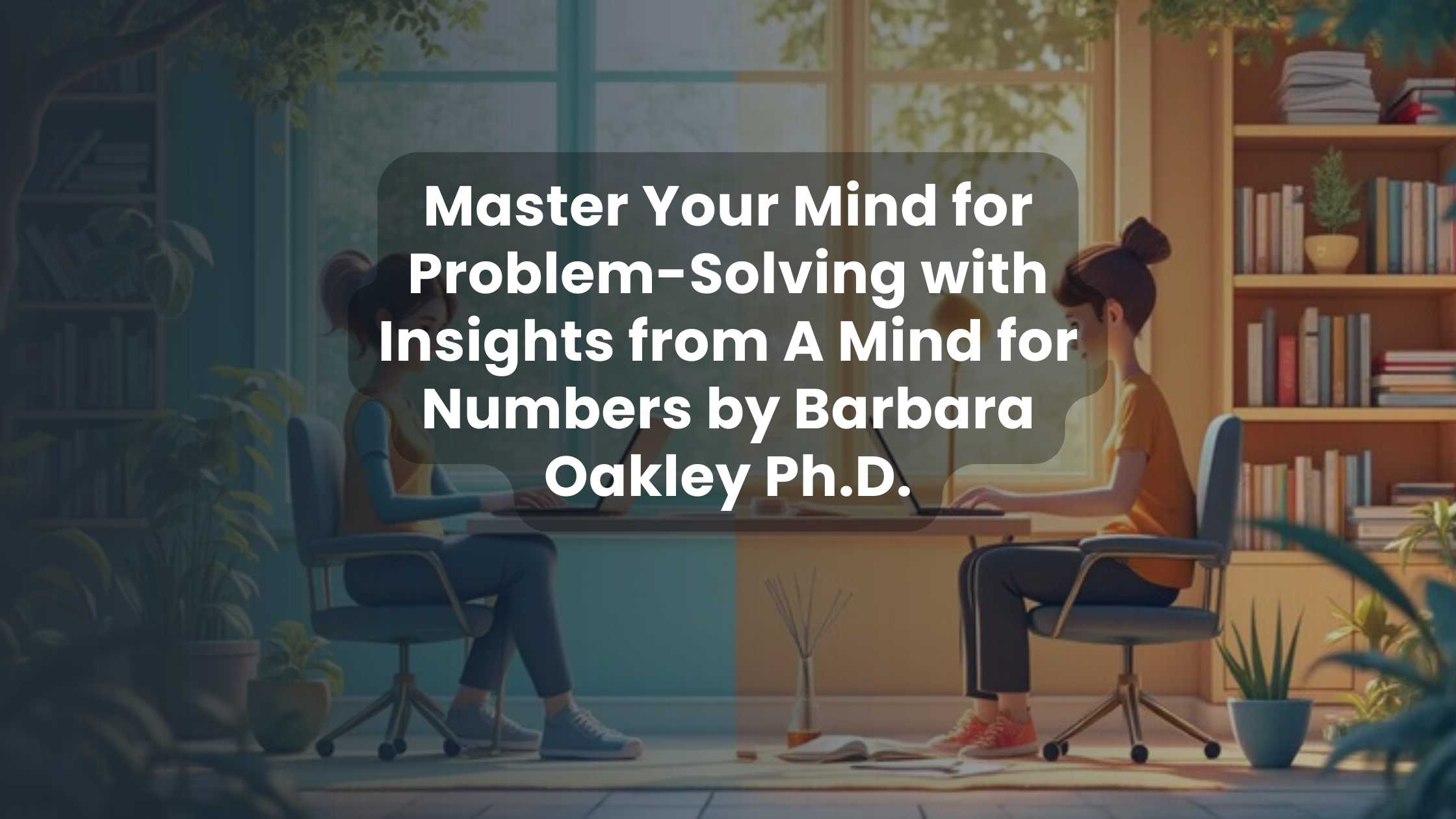
Master Your Mind for Problem-Solving with Insights from A Mind for Numbers by Barbara Oakley Ph.D.


In a world brimming with complex challenges, the ability to solve problems effectively has never been more crucial. Barbara Oakley, Ph.D., in her insightful book “A Mind for Numbers,” unravels the intricate dance between two cognitive modes that can transform your approach to learning and problem-solving: focused and diffuse thinking. Understanding how to harness these modes can redefine your intellectual capabilities, making you not just a better learner but also a more adept problem-solver.
Imagine this: you’re grappling with a tough math problem or a complex project. Your focused mode kicks in, allowing you to hone in on the nuances of the task, filtering out distractions for peak concentration. This mode is your analytical powerhouse, essential for dissecting straightforward challenges that require deep reasoning. Yet, what happens when you hit a wall? This is where the magic of diffuse mode comes into play. By allowing your mind to wander, you unlock a reservoir of creativity that fosters unexpected connections and insights.
Navigating between these two modes skillfully is not just a technique; it’s an art that can lead to innovative solutions to life’s myriad challenges. From academic pursuits to everyday decision-making, mastering this cognitive transition can enhance the way you approach problems, enabling you to blend the precision of focused thinking with the expansive creativity of diffuse thinking. As we delve into the principles outlined in Oakley’s work, you will discover practical strategies to optimize your cognitive toolkit, striking the perfect balance between concentration and creativity. Prepare to embark on a journey of mental mastery that will empower you to tackle problems with renewed vigor and insight.
Mastering Focused Mode for Enhanced Problem-Solving
Mastering focused mode is crucial for enhancing problem-solving skills, as it enables individuals to concentrate intensely on specific challenges while minimizing distractions. This cognitive state is essential for tackling tasks that demand deep analytical thinking, such as solving complex math problems or developing strategic plans in business. To optimize focused mode, creating a conducive environment is key; for instance, setting dedicated study sessions while employing techniques like the Pomodoro Technique can significantly improve attention management. Moreover, successful problem solvers often balance focused work with moments of diffuse thinking, which fosters creativity and broader idea generation. Research indicates that taking short breaks to engage in creative activities can lead to breakthroughs in understanding, making it vital to incorporate both modes into a learning routine. By intentionally alternating between focused and diffuse thinking, individuals can not only enhance their problem-solving capabilities but also cultivate a more innovative mindset.
Unlocking Creative Potential with Diffuse Mode
Explore the power of diffuse thinking to foster creativity and generate innovative solutions.
Unlocking creative potential through diffuse thinking is a powerful strategy for fostering innovation and generating unique solutions. Unlike focused mode, which concentrates on specific problems with precision, diffuse mode allows the mind to wander, connecting seemingly unrelated ideas and sparking creativity. Engaging in activities such as walking, meditating, or even pursuing hobbies can enhance this mode, enabling the brain to process information subconsciously. For instance, renowned inventors like Albert Einstein often took breaks to engage in leisure activities, which led to breakthrough ideas while their minds were relaxed. Research suggests that stepping away from a task for just a few moments can significantly improve problem-solving capabilities, demonstrating the effectiveness of this approach. By consciously switching between focused and diffuse thinking, individuals can navigate complex challenges more effectively, leading to innovative solutions that might otherwise remain hidden. This balance not only enhances academic performance but also enriches everyday decision-making, encouraging a continuous cycle of learning and creativity.
Context Matters: Knowing When to Switch Thinking Modes
Context plays a vital role in determining when to switch between focused and diffuse thinking modes. Focused mode sharpens your cognitive abilities, enabling you to tackle specific problems with precision by eliminating distractions and promoting analytical reasoning. For instance, when preparing for an exam, dedicated study sessions can enhance retention, especially when combined with techniques like the Pomodoro Technique, which segments study time into manageable intervals. However, when faced with complex challenges or creative blocks, embracing diffuse mode becomes essential. This mode encourages your mind to wander, allowing for the generation of new ideas and connections, often sparked by activities such as walking or meditating. Successful learners intuitively navigate between these modes, blending intense focus with periods of reflection and creativity; for every hour spent on focused study, a 15-minute break for diffuse thinking can significantly enhance overall understanding and retention. By being intentional about scheduling focused work and allowing time for creative exploration, individuals can foster a balanced approach to problem-solving that not only improves academic performance but also cultivates innovative solutions in everyday life.
Integrative Learning: Blending Focused and Diffuse Modes
Integrative learning thrives on the harmonious blend of focused and diffuse modes of thinking, enabling learners to tackle challenges with both precision and creativity. Focused mode sharpens the mind’s ability to dissect complex problems, filtering distractions to enhance analytical reasoning; for example, students preparing for exams often engage in intense study sessions that require undivided attention. Conversely, diffuse mode encourages a broader perspective, allowing ideas to intermingle and fostering creativity through activities like walking or meditating. This dual approach is particularly effective when faced with difficult decisions; one can gather concrete information through focused thinking and subsequently step back to explore innovative solutions in diffuse mode. By intentionally alternating between these cognitive processes—such as dedicating an hour to concentrated study followed by a 15-minute creative break—learners can unlock deeper insights and improve problem-solving skills. Ultimately, embracing both modes not only enriches the learning experience but also cultivates a more adaptable mindset, essential for navigating an increasingly complex world.
Achieving Balance: Daily Applications of Focused and Diffuse Thinking
Achieving a balance between focused and diffuse thinking is essential for maximizing cognitive performance and creativity. Focused thinking allows individuals to dive deeply into specific problems, honing in on details while filtering out distractions; this mode is crucial for tasks like solving math equations or preparing for exams. For instance, employing techniques such as the Pomodoro Technique—where one studies for 25 minutes followed by a 5-minute break—can significantly enhance concentration and retention. Conversely, diffuse thinking broadens cognitive horizons, enabling creative connections and innovative ideas to surface during periods of mental relaxation, such as taking a walk or engaging in a hobby. Recognizing the context of a problem is vital; straightforward issues benefit from focused thinking, while complex challenges often require the expansive insights generated by diffuse thinking. Successful learners seamlessly transition between these modes, dedicating time to concentrated study before stepping back to allow their minds to wander, which can lead to unexpected breakthroughs. By intentionally structuring their schedules to include both focused work and diffuse activities, individuals can cultivate a more adaptable and effective approach to learning and problem-solving, ultimately enhancing their overall cognitive agility.
Achieving Balance: Daily Applications of Focused and Diffuse Thinking
Achieving a balance between focused and diffuse thinking is essential for optimal cognitive performance and problem-solving. Focused thinking sharpens concentration on specific tasks, making it the go-to mode for analytical reasoning, such as tackling complex math problems or writing a detailed report. However, without the complementary diffuse mode, which encourages creativity and broader idea connections, one may become stuck or miss innovative solutions. For instance, after an intensive study session, taking a walk or engaging in a hobby can stimulate subconscious processing, often leading to sudden insights that would not arise during concentrated effort. The key lies in recognizing the context: while focused thinking is effective for straightforward challenges, diffuse thinking shines in complex scenarios that require creative exploration. By intentionally scheduling focused work periods followed by breaks for diffuse activities, learners can enhance their understanding and retention of information. Celebrating small victories and reflecting on insights gained from both modes strengthens this cognitive flexibility, empowering individuals to navigate their daily lives with greater creativity and effectiveness.
Celebrating Growth: Tracking Progress in Your Cognitive Journey
Celebrating growth in your cognitive journey is crucial for recognizing the strides you make in learning and problem-solving. Each step forward, whether big or small, contributes to your overall cognitive development and should be acknowledged. For instance, by deliberately practicing focused thinking—where you immerse yourself in a complex problem while minimizing distractions—you can boost your analytical skills significantly. Research indicates that students who utilize techniques like the Pomodoro Technique often report enhanced concentration and retention of information. However, it is equally important to embrace diffuse thinking, which allows your mind to wander and connect disparate ideas creatively. Engaging in activities such as walking or meditating can help facilitate this mode, leading to unexpected insights and solutions. The ability to switch between these modes effectively is a hallmark of successful learners. For example, a student might spend an hour studying intensely for an exam but then take a 15-minute break to doodle or daydream, allowing their brain to process the information more holistically. By celebrating these moments of progress and maintaining a reflective journal, you not only reinforce your learning strategies but also cultivate a deeper appreciation for your cognitive journey. This balanced approach to focused and diffuse thinking not only enhances academic performance but also fosters innovative problem-solving skills in everyday life.
Building Resilience Through Continuous Learning and Adaptation
Building resilience through continuous learning and adaptation is essential in today’s rapidly changing world. This process involves not only acquiring new knowledge but also refining the ability to navigate challenges and seize opportunities. For instance, individuals who effectively blend focused and diffuse modes of thinking can enhance their problem-solving capabilities. Focused mode, where the mind narrows its attention on specific tasks, allows for deep concentration, making it ideal for analytical challenges like studying for exams. Conversely, diffuse mode encourages creative thinking, helping to generate innovative ideas through activities such as walking or engaging in hobbies. Research shows that alternating between these modes can improve overall cognitive function, leading to better retention and understanding. By intentionally scheduling study sessions and incorporating breaks for creative exploration, learners can foster a culture of resilience and adaptability. Celebrating small victories along the way, such as recognizing moments of insight or breakthroughs, reinforces this ongoing journey, making one more adept at facing future challenges.
Conclusion
In conclusion, mastering your mind for problem-solving is a journey that requires understanding and skillful management of both focused and diffuse thinking modes, as outlined in Barbara Oakley’s “A Mind for Numbers.” By embracing focused mode, you can tackle specific challenges with clarity and concentration, enhancing your analytical capabilities. However, it is equally important to engage diffuse mode, which allows for creativity and the synthesis of new ideas, often leading to those “aha” moments that can reshape your understanding of a problem.
As you navigate through your learning and problem-solving processes, remember that context plays a crucial role in determining which mode to employ. Recognizing when to switch gears between focused and diffuse thinking can help you break through mental blocks and inspire innovative solutions. Practical strategies, such as the Pomodoro Technique and intentional breaks, can facilitate this transition and optimize your cognitive performance.
Moreover, celebrating your progress—no matter how small—reinforces your learning journey and strengthens your ability to apply these cognitive strategies. By keeping a journal of insights gained from both modes, you can build a reservoir of knowledge that not only aids in academic pursuits but also enhances your overall problem-solving skills in everyday life.
Ultimately, the art of problem-solving lies in the harmonious balance between focused and diffuse thinking. By cultivating this balance, you empower yourself to approach challenges with a multifaceted perspective, transforming obstacles into opportunities for growth and discovery. Embrace the process, trust in your ability to learn, and watch as you become a more adept problem-solver, ready to tackle whatever comes your way.
FAQ
FAQ Section for Master Your Mind for Problem-Solving with Insights from A Mind for Numbers by Barbara Oakley Ph.D.
What is focused mode, and why is it important for problem-solving?
Focused mode is a mental state where your brain concentrates on a specific problem, filtering out distractions to achieve maximum cognitive efficiency. It is crucial for tasks requiring deep concentration and analytical reasoning. To optimize this mode, set aside dedicated study time, eliminate distractions, and consider techniques like the Pomodoro Technique, which helps manage attention and maintain focus.
How does diffuse mode contribute to creative thinking?
Diffuse mode allows your mind to wander, fostering creativity and enabling the connection of broader ideas. This mode is essential for brainstorming and exploring new concepts. Engaging in activities such as walking, meditating, or pursuing hobbies can enhance diffuse mode, allowing your brain to process information subconsciously and generate valuable insights.
Why is context important when switching between focused and diffuse modes?
Context plays a significant role in determining which mode of thinking is appropriate for a given situation. Focused mode is best for straightforward problems that require concentrated effort, while diffuse mode is more suitable for complex issues that demand creativity. If you encounter a mental block during focused work, taking a break to let your mind wander can lead to a refreshed perspective and new ideas.
Can you provide examples of how to effectively use both modes for learning?
Successful learners know how to switch between focused and diffuse modes. For instance, when studying for an exam, you might spend hours in focused study followed by a break that allows your mind to relax. This combination enables your brain to process information subconsciously. A practical approach is to blend both modes by dedicating an hour to focused study followed by a 15-minute break for creative activities.
What tips can help me transition between focused and diffuse thinking?
To effectively transition between modes, consider the following strategies: schedule specific periods for focused work and breaks for diffuse thinking, reflect on your learning to reinforce knowledge after study sessions, and change your environment to stimulate diffuse thinking. Different locations can inspire new ideas and enhance creativity.
How can I balance focused and diffuse thinking in my daily life?
Applying both modes can enhance not only academic performance but also general problem-solving skills. When faced with a challenging decision, gather information using focused thinking, then take a step back to explore creative options through diffuse thinking. This balance can lead to innovative solutions and a more holistic approach to problem-solving.
Why is it important to celebrate progress and engage in continuous learning?
Celebrating small victories in your learning journey is essential. Acknowledging your ability to switch between focused and diffuse thinking can boost motivation and reinforce your cognitive strategies. Maintaining a journal to track insights from both modes can further enhance your effectiveness as a problem-solver, making you more adept in your learning and personal growth.